PART 2 :
She had given up on love a year and a half ago. Her last fiance had been exposed as a fraud who was secretly siphoning her funds. Men only saw her wallet, never her heart. The betrayal had cut her so deep that she built a solid wall around her emotions. She fired anyone who tried to get too close. She pushed away friends who tried to set her up on dates.
She decided that building her empire was the only safe investment she could make. Because of her hardened heart, her massive estate felt like a graveyard, and her success felt completely empty. So, she worked late, ‘ ‘ came home late, ate meals she barely tasted, and tried not to think too much about the emptiness.
She would pour herself a glass of wine, look out over the glittering lights of the city from her balcony, and tell herself that she was fine. Power and money is better than love, which causes heartbreak. Loneliness was better than betrayal. As she stood there holding her expensive bottle of wine, her thoughts were interrupted by a commotion ahead of her.
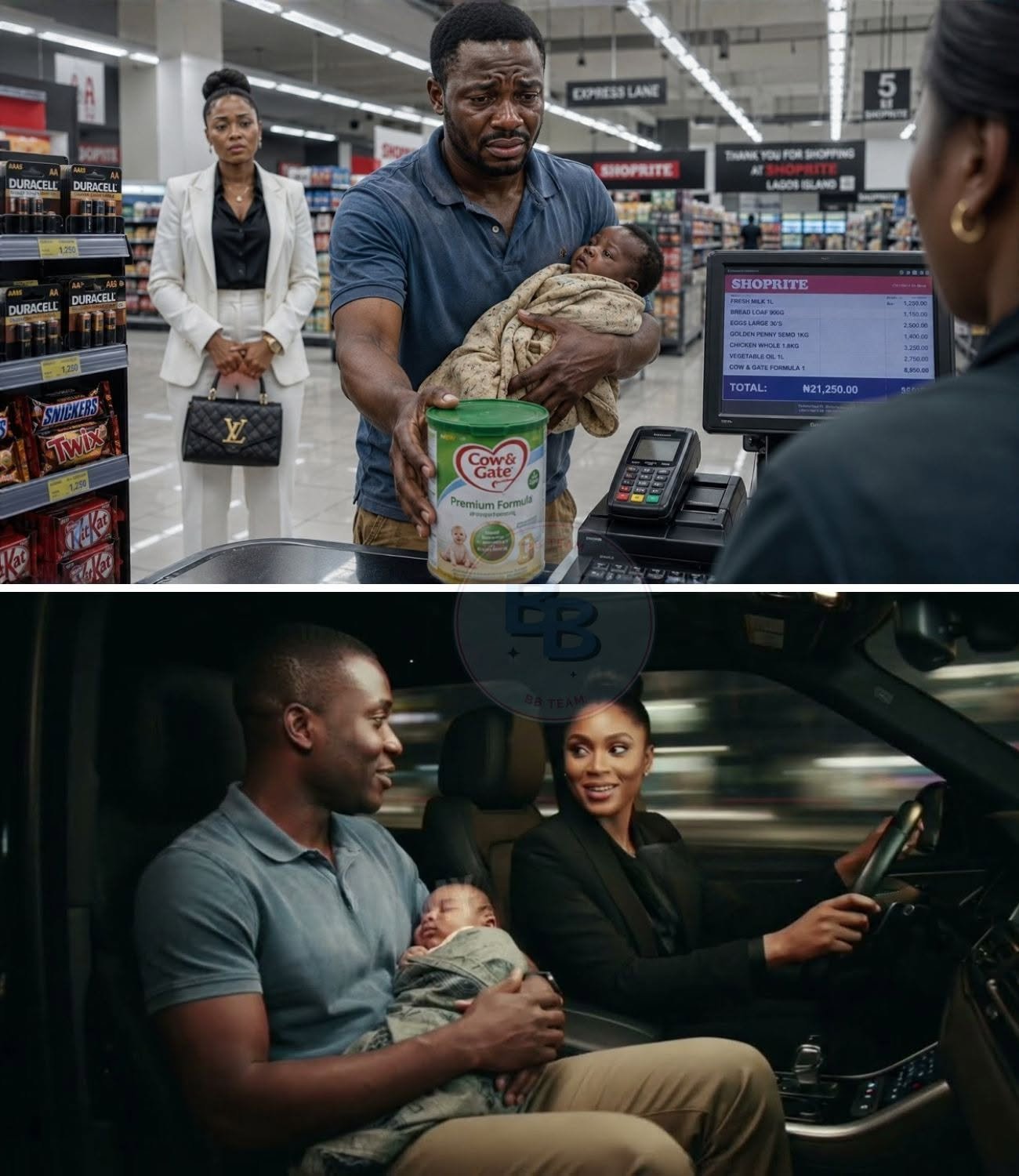
The line moved forward, and Janet found herself standing behind a young man who was clearly having some kind of issue with his card. He wore a faded shirt that had seen better days, and held an infant in his arms, maybe 4 or 5 months old. He looked exhausted, and his face carried the heavy burden of someone who had been beaten down by life.
A young girl, perhaps 3 or 4 years old, stood beside the man, wearing a faded dress and looking up at her father with worried eyes. She was holding on to his trousers. ‘ ‘ Janet usually ignored people. She was used to minding her business, but something about the desperation radiating from the man caught her attention. “I’m sorry.
” the young man was saying to the cashier, his voice with emotion. “I need to return this. I thought I had enough on my card, but it was declined. I don’t have the cash right now.” He was holding a tin of baby formula. It was a premium brand of baby formula, one of the most expensive on the shelf. The man looked at it as if his entire life depended on it.
His hands were slightly trembling. Janet watched quietly from behind, feeling a strange tightening in her chest. The cashier, a middle-aged woman with the tired patience of someone who had seen everything, was already processing the return. “That’s fine, my brother. Do you have your receipt?” “Yes, here.” The young man fumbled in his worn pocket with one hand while balancing the baby with the other.
He found the crumpled receipt and handed it over. The paper was barely legible, worn out from being held tightly in sweaty palms. Janet watched as he held the baby closer, as if trying to shield the infant from the terrible indignity of this moment. The older child tapped on her father’s faded trousers.
“Daddy, is the baby going to be hungry?” the little girl asked, her voice innocent but with a very adult kind of anxiety. “Shh, Amara. ‘ ‘ It’s okay. We will figure it out.” But the young man’s voice cracked, ‘ ‘ and Janet saw him blink rapidly, fighting back tears. It was the sight of a man trying desperately to hold onto his last shred of dignity in front of his child.
Janet noticed the way the man swallowed hard, looking away from the cashier as the transaction was canceled. She didn’t know his story, but the struggle was showing all over him. His name was Timothy. Only a few months ago, his wife, Joyce, had packed her bags and walked out the door. She had screamed that she could not eat love, that she was tired of suffering, tired of a husband who could not provide the luxury she felt she deserved.
She left him with a newborn and a toddler, disappearing into the city and leaving him to figure out how to be both a mother and a father with zero naira in his bank account. He had spent the whole day walking from one construction site to another looking for daily wage labor, carrying his children because he had no one to leave them with.
‘ ‘ The cashier completed the return and handed back a small amount of cash. Here you go. Have a better evening. Thank you. The man took the money with a shaky hand and turned to leave. The pure defeat in his posture was loud. The baby started to whimper, feeling the tension in her father’s arms. And something inside Janet broke.
She didn’t plan it, didn’t think about it, just acted on an impulse that felt like the first genuine thing she had done in 2 years. She had spent so much time protecting her wealth from greedy men, but looking at this man, she saw no greed. She only saw a father who was breaking apart for his children.
“Excuse me,” she called out. The young man turned, his expression wary. He was younger than she had initially thought, probably late 20s or early 30s. His face was drawn with extreme exhaustion and worry, but there was dignity there, too. A quiet strength that came from enduring more than anyone should have to. He looked at her perfectly tailored suit, her flawless makeup, and took a small step back, clearly intimidated by her presence.
“I couldn’t help but overhear,” Janet said, already pulling out her designer wallet. “Let me buy that formula for you and whatever else you need.” The man’s eyes widened ‘ ‘ then filled with a mixture of shock and unshed tears. “I can’t. I can’t accept that.” “Why not?” she asked. “Because I don’t take charity. I’m a man. I am managing.
I just miscalculated my balance tonight. I will figure something out.” He stood tall despite his worn clothes. He was a father trying to protect his pride. The baby in his arms began to fuss, making small hungry sounds. The little girl, Amara, looked between her father and Janet with hopeful eyes.
The little girl rubbed her stomach quietly. “It’s not charity.” Janet said gently, surprised by the softness of her own tone. “It’s one human being helping another. Please let me do this.” She stepped closer. She wasn’t looking down on him. She was asking for permission to be kind. She could see the brutal war playing out on his face.
A man’s pride versus his children’s need, his dignity versus pure desperation. The baby’s cries grew more insistent, and that finally decided it. “Okay.” He whispered, his voice defeated. “Thank you. Just the formula. That is all I need.” But Janet had already turned to the cashier. “Ring up the formula and whatever else he came in to buy.” “Just the formula.
” The man protested again, stepping forward. “My friend.” The cashier said, her tired face softening into something like true compassion. “Let the madam help. The Lord knows we all need help sometimes.” Reluctantly, the young man placed a few other items on the belt. A loaf of bread, a small sachet of milk, some bananas, and a cheap pack of noodles.
Basic staples. The kind of groceries that revealed someone living on the very edge, making every single naira stretch. Janet looked at the petty items. It was barely enough to feed a grown man, let alone a growing child. Janet handed her black premium credit card to the cashier.
“Add my items, too, and give me three more tins of that formula.” “Madam, that’s too much.” Timothy said, his voice laced with panic. “It’s not too much. It’s barely anything.” And it was true. The entire transaction would cost her less than the bottle of expensive wine in her hand, less than the lunch she had ordered for her boardroom meeting that afternoon.
To her, the money was invisible. To him, it was a lifeline. The young man stood silently while the cashier bagged everything. The older child, Amara, tugged on Janet’s tailored coat sleeve. ‘ ‘ “Are you a helper?” she asked with the directness of small children. Janet looked down at the little girl. The innocent question pierced right through the thick walls she had built around her heart.
“I’m trying to be,” Janet said, crouching down to her level, ignoring the fact that her expensive suit pants might brush against the supermarket floor. “What’s your name?” ‘ ‘ “Amara.” “That’s my daddy, Timothy.” Amara pointed her little finger. “And that’s my baby brother, Benjamin. Benjamin is always hungry. He cries a lot.
” “Amara, don’t bother the madam,” Timothy said, deeply embarrassed. ‘ ‘ He tried to pull his daughter back gently. “She’s not bothering me.” Janet stood up and accepted the receipt from the cashier, then handed the heavy bags to Timothy. “I’m Janet, by the way.” “Timothy. And I don’t know how to thank you.
This is You have no idea what this means.” He looked at the bags of food, his eyes swimming with overwhelming relief. “I think I do,” Janet said quietly. And she did, somehow. Not from experience with hunger or deep poverty, but from knowing what deep desperation felt like. What it meant to be at the absolutely end of your resources, and feeling totally unsure how to keep going.
She remembered the night she found out about her ex-fiancé’s betrayal. The feeling of the ground completely disappearing from beneath her feet. Emotional poverty was different from financial poverty, but the feeling of drowning was exactly the same. They walked out of the store together into the cool night air.
The massive parking lot was nearly empty. The security guards were sitting by the gate justing. Timothy headed toward the dark road at the edge of the lot, balancing the baby and the heavy grocery bags. You’re taking public transport? Janet asked, walking quickly to catch up with him. With the baby and all these groceries? It’s not far.
Just a few bus stops. He didn’t turn around, trying to hurry away so he wouldn’t impose any further. Let me drive you home. Timothy stopped walking. I’ve already accepted too much help for one night. Timothy, it’s late. You have two small children and heavy bags of groceries. Please let me drive you. My car is right here.
She gestured to her expensive black SUV, the kind of vehicle that loudly announced serious wealth and success. Timothy looked at the luxury car, then at his tired daughter who was rubbing her sleepy eyes, and his fussing infant. He finally nodded. Okay, thank you. We stay around the mainland side. Do you know the route? Janet did.
It was the kind of area people referred to as developing, which really meant it was noisy and full of people working very hard to climb out of poverty. She unlocked the car. She helped him load the groceries into the trunk while Timothy settled the children in the plush leather back seat. Benjamin had started crying, that loud newborn cry that spoke of hunger.
Janet started the engine. The air conditioning immediately cooled the inside of the vehicle. As Janet drove, navigating the busy roads that connected the island to the mainland, Timothy tried to soothe the baby. I know, my boy. I know you’re hungry. Just a few more minutes and we will be home.
He rocked gently, his voice full of an immense, tender love that made Janet grip the steering wheel tighter. It had been so long since she saw a man display such pure, unconditional affection without expecting anything in return. How old is he? Janet asked, keeping her eyes on the road. 4 months. Almost five. And Amara just turned four.
She’s a wonderful big sister. Timothy’s voice was warm when he talked about his children. All the stress and intense worry seemed to be temporarily forgotten. “Are you doing this alone?” Janet asked, then immediately regretted the intrusive question. “I’m sorry. That’s none of my business.” “It’s okay, and yes, I am. Their mother left shortly after Benjamin was born.
She decided the poverty was too much, that she wasn’t cut out for this kind of struggling family life.” There was no bitterness in Timothy’s voice, ‘ ‘ just a very heavy, tired acceptance. Janet felt a sharp sting of anger on his behalf. How could a mother leave her children just because things got difficult? How could anyone abandon a man who clearly loved his family this much? It shattered her preconceived notion that all men were the users and all women were the victims.
“It’s been hard, but we manage.” Timothy continued softly. “What do you do for work?” “I mean, ‘ ‘ I was working as a factory loader, but the company closed down last month due to the economy. I’ve been looking for something new, ‘ ‘ but it is very hard with two kids and no money for a nanny. I have some places I go to ask for daily work, but in the meantime,” he trailed off, looking out the tinted window.
“In the meantime, you’re running out of money for essentials like baby formula.” Janet finished for him. “I’ll figure it out. I always do. God will provide. I have a neighbor who sometimes helps watch the kids for an hour or two. ‘ ‘ Something will surely come through.” His faith was unshaken even in the dark.
As they crossed the bridge into the mainland, the scenery changed drastically. The well-lit paved roads of the island gave way to pothole-ridden streets, ‘ ‘ crowded corners, and flickering streetlights. Janet followed Timothy’s directions, turning down narrower and darker streets.
The smooth ride of her luxury SUV became bumpy as the tarred road completely disappeared, replaced by red dirt and deep ditches. “Take a left here. Timothy instructed quietly, pointing toward a pitch-black path. Janet turned the steering wheel, her headlights cutting through the darkness. She expected him to point out a house, even if it is old, but instead, Timothy told her to stop in front of a dark structure.
Janet pressed the brakes and put the car in park. She looked out of her window, trying to adjust her eyes to the darkness. Her heart dropped. It wasn’t an apartment building. It was an abandoned, uncompleted building project. Thick concrete pillars held up a roof, but there were no actual walls, no windows, and no doors.
See more on the next page
For Complete Cooking STEPS Please Head On Over To Next Page Or Open button (>)