e wrote the final one herself.”
“Are you sure?”
Walter paused.
He had recognized the handwriting. Yet even after forty years, something about the message had never felt right.
Noah could not stop thinking about the story. He told his grandmother, Margaret, who had grown up in Maplewood.
The moment she heard Eleanor Bennett’s name, her face changed.
“Eleanor didn’t abandon Walter,” she whispered.
Margaret explained that Eleanor’s father, Charles Bennett, had strongly opposed their relationship. He believed Walter, the son of a poor mechanic, could never provide the life his daughter deserved.
After Walter left, Charles intercepted his letters.
He hid them in a locked drawer.
Then he forced Eleanor to leave Maplewood and live with an aunt in another state. He told her Walter had stopped writing and had married someone else.
Eleanor, brokenhearted, wrote dozens of letters, but her father never mailed them.
The cruel final letter Walter received had been copied from Eleanor’s handwriting by her older cousin under Charles’s command.
Noah immediately told Walter.
For several minutes, the old man could not speak.
The truth he had waited forty years to hear brought no anger at first—only grief.
“She thought I abandoned her,” he whispered.
Margaret remembered hearing that Eleanor had become a schoolteacher in Vermont. Noah and his grandmother searched old directories and contacted several schools.
Three days later, they found her.
Eleanor Bennett was now Eleanor Bennett Shaw. She had married briefly in her thirties, but her husband had died after only two years. She had no children and had recently moved into a retirement community.
When Noah called her and mentioned Walter Hayes, the phone went silent.
Then Eleanor began to cry.
“I waited beneath that tree for two years,” she said. “My father told me Walter never came home.”
Noah told her the truth.
The next evening, the whole town seemed to sense that something important was about to happen.
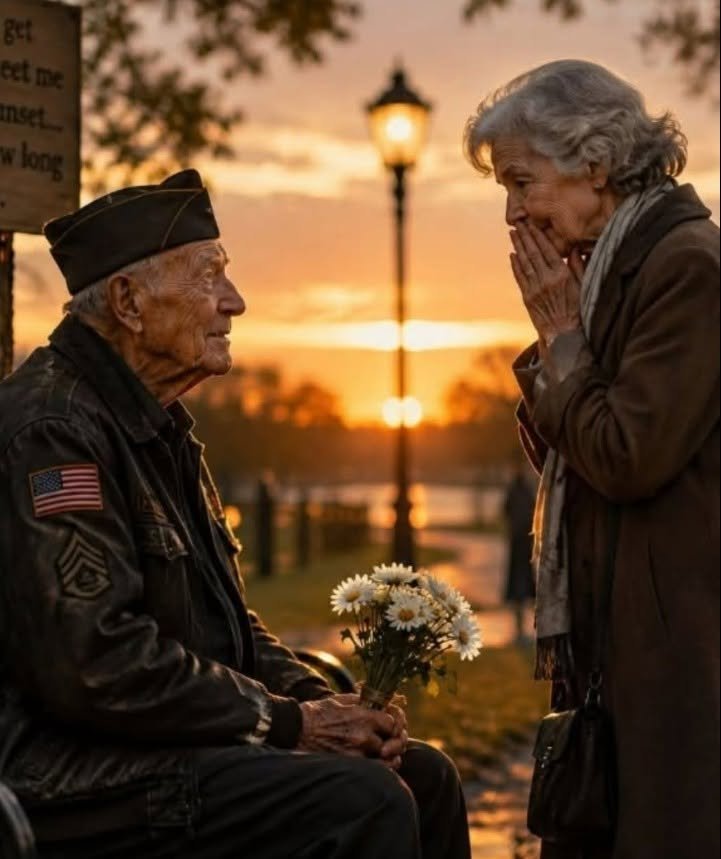
Walter sat beneath the oak tree with his daisies resting beside him.
At exactly 6:15, a dark car stopped near the park entrance.
An elderly woman stepped out.
Her silver hair was pinned neatly behind her head. She walked slowly with a cane, but her green eyes were unmistakable.
Walter rose unsteadily.
For a moment, they simply stared at each other across the snow-covered path.
Then Eleanor spoke the words Walter had imagined for forty years.
“I’m sorry I’m late.”
Walter’s lips trembled.
“I promised I would wait.”
Eleanor reached him and placed both hands around his face.
“I never stopped loving you.”
Walter pulled her into his arms.
Around them, townspeople stood quietly beneath the falling snow. Some cried openly. Noah held his grandmother’s hand and smiled.
Walter and Eleanor sat together on the bench until the sunset disappeared.
They spoke about the letters, the years stolen from them, and the lives they had lived apart.
There was sadness in their reunion, but there was no bitterness.
They understood that anger could not return the lost years. They could only decide what to do with the time that remained.
Three months later, Walter and Eleanor were married beneath the old oak tree.
Noah carried the rings.
The entire town attended.
Walter wore his Army jacket, freshly cleaned and carefully repaired. Eleanor carried a bouquet of white daisies.
They spent four beautiful years together in the small white house Walter had once imagined. Eleanor planted a garden. Walter built her a reading bench. Every evening at 6:15, they walked to Maplewood Park and watched the sunset side by side.
When Walter passed away peacefully at the age of eighty-one, Eleanor found a note beside his bed.
My dearest Eleanor,
Our time was shorter than we deserved, but greater than I ever dreamed. I kept my promise because love taught me that hope is not foolish when the heart knows the truth.
Meet me beneath the old oak tree when your final sunset comes.
I will be waiting.
Eleanor folded the letter against her heart.
For the next three years, she continued visiting the bench at 6:15, carrying white daisies for Walter.
After her death, the town placed a small bronze plaque beneath the oak tree.
It read:
“True love is not measured by the years two people spend together, but by the promises they never stop keeping.”
The bench became a place where people came to forgive, reconcile, and remember what truly mattered.
And whenever the evening sun touched the lake, the old oak tree seemed to hold the memory of two young hearts separated by lies—but reunited by truth, courage, and a promise stronger than time.
Moral
Misunderstandings can steal years, pride can destroy families, and silence can wound more deeply than words. Never allow assumptions to replace honest communication, and never let fear prevent you from seeking the truth.
Real love is patient, forgiving, and faithful. It does not erase pain, but it gives us the strength to heal. Some promises may take a lifetime to fulfill, but a sincere heart never forgets the road home.
See more on the next page
Advertisement