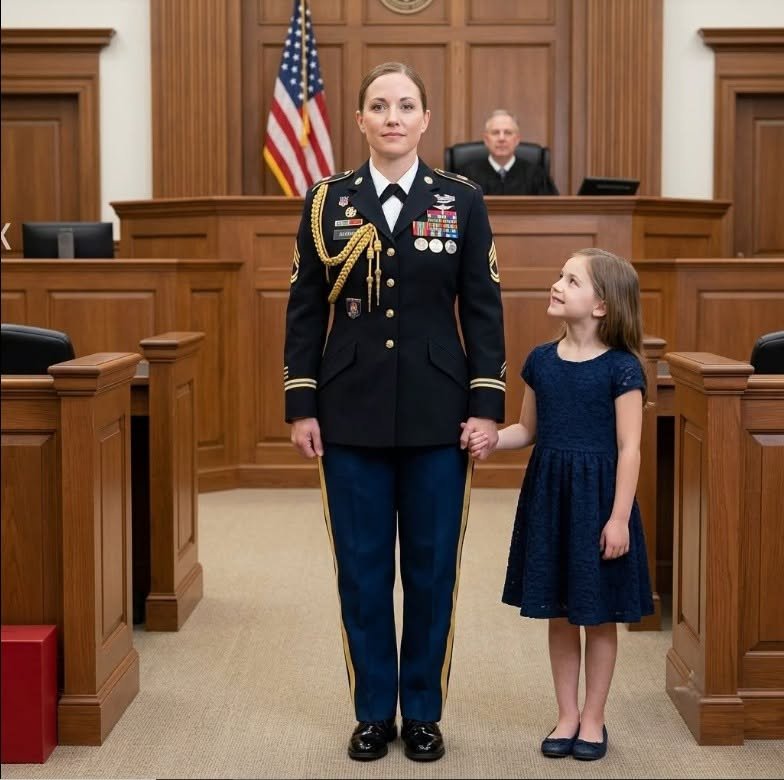
Margaret Harrison walked into court like she owned my daughter, then left like she was afraid of her own name.
David’s attorney spoke for forty minutes.
He had a smooth voice.
Expensive shoes.
The kind of confidence men get when they believe a woman without a lawyer is already beaten.
He described me as “rigid.”
“Emotionally distant.”
“Unable to fully transition from military life.”
He said David could provide “stability.”
He said Margaret offered “extended family support.”
He said Emily needed a home that was “less tense.”
While he spoke, Margaret sat behind him with her chin lifted.
She looked at me as if she expected me to explode.
I did not.
I wrote down every claim.
One by one.
When it was my turn, I stood with my yellow legal pad.
My knees were steady.
My hands were steady.
My voice was steady.
“Your Honor, I’d like to begin with Mr. Harrison’s statement that I withdrew from family life.”
Judge Simmons nodded.
“Proceed.”
David took the stand.
He would not look at me at first.
I asked my first question.
“Who attended every parent-teacher conference Emily has had since kindergarten?”
He shifted.
“You did.”
“Who volunteered every Friday in her classroom last year?”
“You did.”
“Who coached her soccer team when you were traveling for work?”
“You did.”
“Who took her to the dentist, the pediatrician, and the emergency room when she broke her wrist on the playground?”
David swallowed.
“You did.”
I paused.
“So when you said I withdrew from family life, what did you mean?”
He glanced at his attorney.
“I meant emotionally.”
I opened binder two.
“Would you like me to read the text you sent after Emily’s spring concert?”
His attorney stood.
“Objection.”
Judge Simmons looked at him.
“On what basis?”
The attorney sat back down.
I read the text.
Rebecca, thanks for handling everything with Emily. I don’t know how you keep all this straight. You’re the reason she’s doing so well.
David stared at the floor.
The courtroom shifted.
Tiny movement.
Huge meaning.
Then came the PTSD accusation.
His attorney had been careful.
He did not say I had PTSD.
He suggested it.
He placed the word in the air like smoke and hoped the judge would breathe it in.
So I asked David directly.
“Did any doctor ever diagnose me with PTSD?”
“No.”
“Did I ever threaten Emily?”
“No.”
“Did I ever miss a school pickup because of emotional instability?”
“No.”
“Did you sign a sworn custody petition suggesting my military service made me a risk?”
He looked miserable now.
“Yes.”
“Was that based on medical fact?”
Silence.
“Mr. Harrison?” Judge Simmons said.
“No.”
Margaret’s face stiffened.
The first wall cracked.
Then I moved to the money.
Certified bank statements.
Transfer dates.
Discovery emails.
Branch notes.
I handed copies to the clerk.
David’s attorney objected twice.
Both times, the judge overruled him.
I asked David when he decided to separate the savings.
“I don’t remember.”
“You don’t remember moving nearly eighty thousand dollars?”
“It was financial planning.”
I opened binder one.
“Is this your email to your financial advisor four months before filing for divorce?”
He leaned forward.
His face changed before he answered.
“Yes.”
“Please read the highlighted sentence.”
His voice came out flat.
“I want everything separated before she realizes what’s happening.”
Margaret whispered, “That’s out of context.”
Judge Simmons looked at her.
“Mrs. Harrison, one more interruption and I will ask you to leave.”
Her lips pressed together.
For once, she obeyed.
Then I introduced phone records.
Calls between David and Margaret before and after each transfer.
Texts about “timing.”
A message from Margaret saying, Move faster. Once she gets a lawyer, this gets harder.
David looked smaller with every exhibit.
But Margaret still had one card left.
Herself.
When she took the stand, she smiled like a woman stepping into a church committee meeting.
She called me cold.
Controlling.
“Not naturally maternal.”
She said Emily seemed “nervous” around me.
She said the teacher had “hinted” I was too intense.
I let her talk.
Tom’s voice echoed in my memory.
Don’t interrupt a lie while it is exposing itself.
When my turn came, I picked up one sheet of paper.
“Mrs. Harrison, did Emily’s teacher ever tell you I was an unfit parent?”
Margaret tilted her head.
“She expressed concern.”
“What exact words did she use?”
“I don’t recall exactly.”
“Was it at school?”
“I believe so.”
“What date?”
“I don’t remember.”
“What was Emily wearing?”
Her eyes narrowed.
“What kind of question is that?”
“The kind that helps honest people remember real conversations.”
A quiet sound moved through the courtroom.
Not laughter.
Recognition.
I handed the teacher’s letter to the clerk.
Judge Simmons read it.
His face stayed calm, but his eyes sharpened.
Then he read one line aloud.
“At no time have I expressed concerns regarding Mrs. Harrison’s parenting. In my professional opinion, Emily is secure, prepared, loved, and strongly bonded with her mother.”
Margaret’s mouth opened.
No sound came out.
The second wall fell.
Then I brought out the voicemail.
David’s attorney stood before I even finished my sentence.
“Your Honor—”
Judge Simmons raised one hand.
“I will hear the foundation first.”
I explained the date, time, phone number, and preservation copies.
The judge allowed it.
The clerk pressed play.
Margaret’s voice filled the courtroom.
“David, stop being soft. If we’re going to win custody, the judge doesn’t need the truth. He needs doubt. Make Rebecca sound unstable long enough, and we’ll take Emily before she knows what happened.”
No one moved.
Not David.
Not his attorney.
Not Margaret.
Even Emily’s child advocate looked up from her notes.
When the recording ended, the silence felt bigger than the room.
Judge Simmons removed his glasses.
“Mrs. Harrison,” he said to Margaret, “this court takes false allegations involving a child’s welfare very seriously.”
Margaret tried to speak.
“Your Honor, that was—”
“No, ma’am.”
Two words.
That was all it took.
She sat down.
For the first time since I met her, Margaret Harrison had nothing to say.
Judge Simmons took a recess.
In the hallway, Emily ran to me from the children’s waiting room.
“Mom?”
I knelt.
She wrapped her arms around my neck.
“You’re doing really good.”
“You barely heard anything.”
“I know,” she whispered. “But you look like you.”
That almost broke me.
Not the accusations.
Not the money.
Not the divorce.
That.
Because children know when their parents disappear inside fear.
And that day, mine saw me come back.
When court resumed, Judge Simmons reviewed his notes for a long time.
Then he looked at David.
“Mr. Harrison, this court has seen no credible evidence that Mrs. Harrison is unstable or unfit.”
David closed his eyes.
The judge continued.
“This court has seen significant evidence that marital funds were moved without transparency while divorce was being planned.”
He turned a page.
“More troubling, this court has heard evidence suggesting an intentional effort to create doubt around a capable parent for strategic advantage.”
Margaret stared straight ahead.
Her pearl earrings did not move.
Judge Simmons looked at me.
“Mrs. Harrison, every independent source before this court—school records, medical records, the child advocate, and testimony—describes you as consistent, involved, and loving.”
My throat tightened.
I did not cry.
I breathed.
He looked toward Emily.
“This court awards primary physical custody of Emily Harrison to her mother, Rebecca Harrison.”
For one second, the world stopped.
Then Emily shouted, “Mom!”
She ran into my arms.
I held her so tightly I felt her rabbit press between us.
“We’re going home?” she asked.
I kissed her hair.
“We’re going home.”
David received scheduled parenting time.
The judge warned both parents against exposing Emily to conflict.
Then he looked directly at David.
“And future decisions about your daughter should be made by her parents, not by outside influence.”
Everyone knew who he meant.
Margaret stood too quickly.
Her purse slipped off her shoulder.
No one helped her pick it up.
Outside the courthouse, the October air felt cold and clean.
David caught up to me near the steps.
“Rebecca.”
I stopped.
Emily stood beside me, holding my hand.
“I’m sorry,” he said.
I studied him.
His face looked tired.
Not evil.
Not innocent.
Just weak in the way people become when they let someone else’s cruelty do their thinking.
“You should have trusted the mother of your child,” I said.
He nodded.
“I know.”
“I won’t keep Emily from you,” I told him. “But I will keep lies away from her.”
His eyes moved to Emily.
“I understand.”
Maybe he did.
Maybe he only understood consequences.
Either way, it was enough for that day.
Margaret stood by David’s truck, watching us.
She did not wave.
She did not call Emily.
She did not say goodbye.
A month later, David’s construction partners found out he had hidden marital assets during divorce proceedings.
One partner asked for a review.
Then another.
By Christmas, David was forced out of the company he helped build.
Not because I ruined him.
Because records do what rumors cannot.
They stay.
Margaret lost more quietly.
Her church friends stopped inviting her to committee lunches after the voicemail spread through the family.
Her charity board asked her to step down.
The woman who once told my daughter she would live somewhere “nicer” spent the holidays alone in a house full of expensive furniture and no one willing to sit beside her.
As for me, I went back to work part-time helping military spouses transition into civilian life.
I helped women update résumés.
Prepare for interviews.
Find housing.
Understand legal paperwork.
Sometimes they sat across from me at a small office near Franklin and said, “I don’t know who I am anymore.”
And I always told them the truth.
“You are not the worst thing someone called you.”
One year after the hearing, Emily and I were cleaning the attic when she found my old dress uniform in a garment bag behind the Christmas boxes.
She unzipped it carefully.
The silver eagle insignia caught the light.
Her eyes went wide.
“Mom,” she whispered. “You really were a colonel.”
I smiled.
“I really was.”
“Why didn’t you tell me?”
I sat beside her on the attic floor.
“Because I didn’t want you to think that was the most important thing about me.”
She touched one of the ribbons.
“Then what is?”
“You.”
She leaned against my shoulder.
For a while, we sat there in the dust and afternoon light, surrounded by old ornaments, forgotten boxes, and the pieces of a life I had once packed away.
Then Emily looked up and grinned.
“You should wear this for Halloween.”
I laughed so hard my stomach hurt.
And in that ordinary, ridiculous, beautiful moment, I understood what winning really meant.
It was not Margaret’s humiliation.
It was not David’s downfall.
It was not even the judge saying, “Good morning, Colonel.”
Winning was my daughter growing up in a house where truth did not have to shout.
Where strength did not have to be cruel.
Where a woman could be underestimated, betrayed, mocked, and still walk out calm with her child’s hand in hers.
People will try to reduce you to the one chapter they think makes you easiest to defeat.
Divorced.
Broke.
Too old.
Too emotional.
Too damaged.
Too quiet.
Let them.
Then bring the documents.
Bring the truth.
Bring the part of yourself they never bothered to know.
And when the room finally goes silent, don’t waste your breath explaining your worth.
Just stand there.
Let the record speak.
See more on the next page